This is the night!
This is the night we remember what God has done. This is the night we will light the Pascal candle. This is the night we will again hear about what God has done. This is the night that we sing Alleluia once more. At Amazing Grace, we will hang up a banner with handprints and alleluias that was made at a church event before Lent started. This is the night that Christ has triumphed over the tomb.
Some of you might be wondering, “Why are we singing Alleluia now? Is this too early? Didn’t Jesus rise on Easter Sunday? Why Saturday night?”
In the ancient Jewish and early Christian calendar systems, the day begins not at sunrise or at midnight, but at sundown the night before. That’s why Sabbath-keeping Orthodox Jews start their Sabbath on Friday nights. So, for us, in this ancient calendar system, we are entering into Easter.
The service we celebrate tonight might be unfamiliar to some Lutherans. There has been a strong movement in recent years by Lutherans in the United States to reclaim the Easter Vigil from the inner bowels of liturgy and theology books. For example, it was only in the minister’s edition of the 1978 Lutheran Book of Worship, but is in the pew edition of the 2006 Evangelical Lutheran Worship.
But in the early centuries of Christianity, this was the night. This was the one time for new Christians to be welcomed into the life of the community through the waters of Baptism. So tonight, we get wet. We will remember our baptism and get sprinkled with water dripping from an evergreen bough. Still soaking from the sacramental rite, those early Christians would then share the feast of Holy Communion. We, too, share this sacred meal tonight.
While practicing for last year’s Vigil, some of the children noticed that we left out a verse from Rise and Shine—the “floodie, floodie” song about Noah and the flood. We did not sing:
This is the end of our story, story. Everything is hunky-dory-dory.
We left it out because it is not the end of the story. God’s story of promise and love does not end when the animals come onto the landy-landy. It is a new beginning—a fresh start.
God’s story does not end when the children of Israel trod with unmoistened foot across the Red Sea waters. It is a new beginning—a fresh start.
God’s story does not end when Jonah gets puked onto the shores on Ninevah. It is a new beginning—a fresh start.
God’s story does not end when Jesus shares the meal and washes his disciple’s feet.
God’s story does not end when Jesus gets betrayed and arrested.
God’s story does not end when Jesus hangs on the cross.
God’s story does not even end when Jesus says “It is finished.”
God’s story does not end when the women find that Jesus has risen.
It is a new beginning—a fresh start.
God’s story keeps on keeping on.
God’s story is the Resurrection.
God’s story is new life.
God’s story becomes our story.
As Christians we gather on Easter because we know that in a broken world, we need the promise of a God who breakes into our story.
Christ is Risen. Alleluia.
Amen. Amen.
Saturday, April 3, 2010

Wednesday, March 31, 2010


Tuesday, March 30, 2010
Political street theater

On Friday, a few of us from Amazing Grace experienced some political street theater near the campus of Our Lady of the Lake University where Westboro Baptist Church was scheduled to protest a theater production of The Laramie Project, a play about Matthew Shepard, the Wyoming man so violently beaten a decade ago. We went to see the play, but to also prayerfully and nonviolently counterprotest this group that regularly protests military funerals, college graduations, and other events. Fred Phelps, their leader, is the example of so much of what I don’t want to be as a Christian.
The evening was a bit anticlimactic. We didn’t see Fred Phelps. We didn’t hear hate-filled shouts. We did however, encounter more of the crowd gathered with signs promoting love. There was some shouting and horn-honking, but for us from Amazing Grace, it was more a night at the theater than a night of political street theater.
Though I love the idea of being vocal about our faith and being a witness of God’s love in the world, marching is certainly not in my comfort zone. I’ve done a few MLK marches, but I always feel a bit anxious and uneasy. Will I get arrested? Is somebody going to get hurt? Am I willing to take risks for what I believe?
The play itself was very powerful. It retells the experience of Laramie residents before and after the attack. After the play, I felt emotionally drained. It’s hard to imagine that such violence exits, and that people can be so hateful.
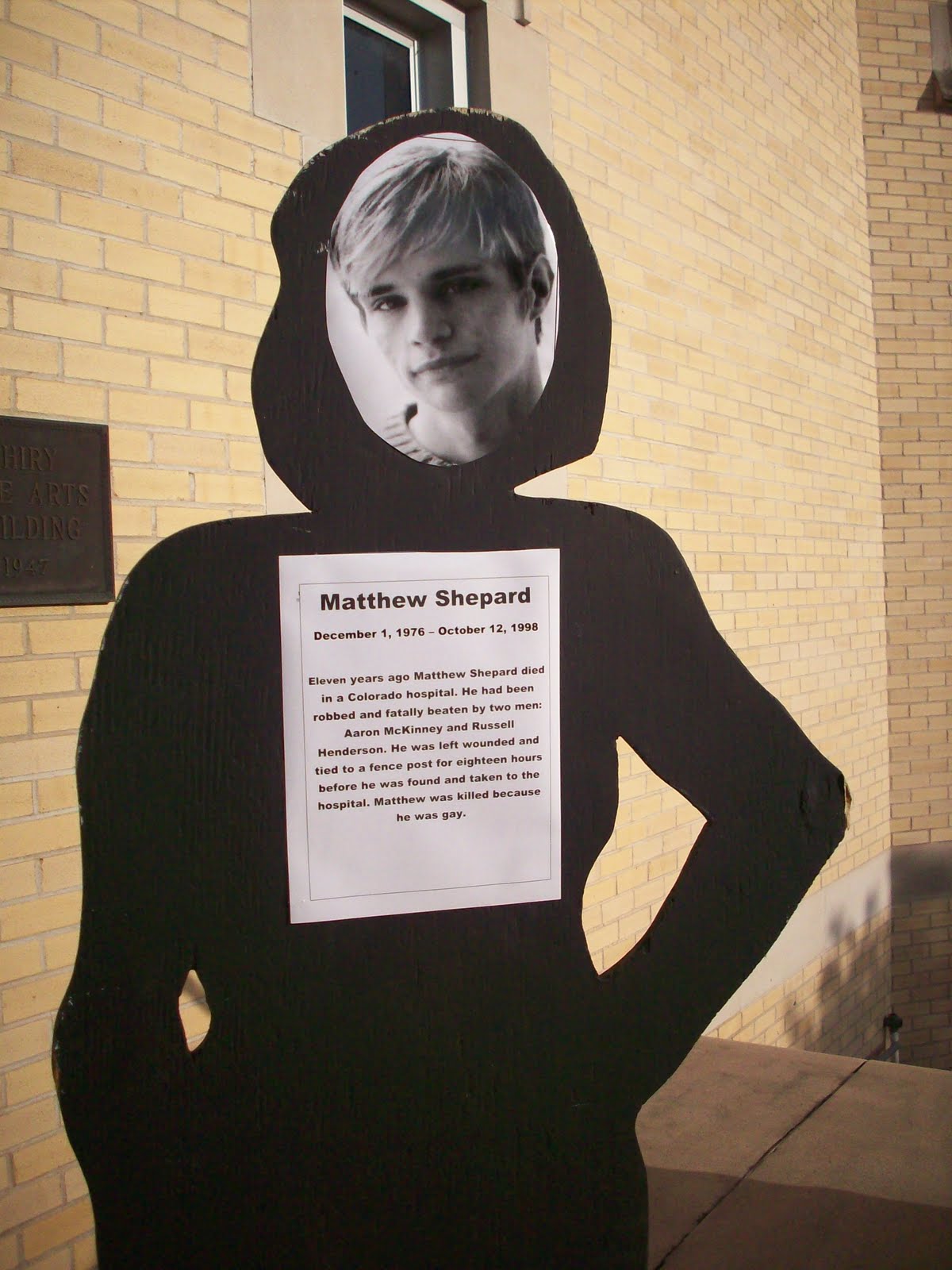
As I watched the play, I was very aware that religion was playing a major role in how people understood the tragedy. Characters included a Unitarian Universalist minister, some sort of Christian Evangelical preacher, a Roman Catholic priest, and Fred Phelps. I noticed an absence of Lutherans. I know that there is a Lutheran congregation in Laramie, and have been there, but wonder now what their response was.
And I wonder what my response would be. If something like that happened here in San Antonio, would I speak out? How would I address it? I pray that I would have courage to remain loving and faithful.
And so, here we are in Holy Week, after the political street theater of Palm Sunday.
And I wonder what my response would be. If something like that happened here in San Antonio, would I speak out? How would I address it? I pray that I would have courage to remain loving and faithful.
And so, here we are in Holy Week, after the political street theater of Palm Sunday.
Wednesday, March 24, 2010
Romero
Today marks the thirtieth anniversary of the death of Archbishop Oscar Romero, the Salvadoran church leader who was assassinated while presiding at Communion in 1980. He courageously spoke out on behalf of those who are oppressed.
Here is the trailer for the 1989 biopic:
I first learned about Oscar Romero in 2001 when I worked at Sky Ranch Lutheran Camp. All the camp’s cabins are named after people who have lived out lives of Christian social justice—including Dietrich Bonhoeffer, Mother Theresa, Desmond Tutu, and Oscar Romero.
For a college class on Old Testament prophets, my assignment was to write a paper comparing a modern figure to people from the Bible. I wrote about Romero and how his actions as bishop in El Salvador were like the calls to social justice found in the teachings of Jesus and the work of Old Testament prophets. Like Amos, Romero called out those who might sell the poor for a pair of sandals (Amos 2:6).
Romero and Jesus spoke out for poor people in extractive economies. In first-century Palestine, then a Roman colony, the people were paying taxes to the Romans, thus making the tax collectors rich. In Romero’s El Salvador, while no longer a Spanish colony, the campesinos were working on plantations they did not own, providing income for the elite land owners. Many of the crops, including bananas, coffee, and sugar, were later sold to markets overseas, including the United States. In a 1980 speech at Louvain, Romero said, “The poor are the body of Christ today. Through them, he lives on in history.”
When I preside at Eucharist and lift up the loaf and chalice, I often think about Oscar Romero. I’ve never felt in danger of being assassinated because of my ministry, but maybe I should be. Maybe I need to start taking a more confident stance in loving my neighbor. When we eat this Body of Christ, we are standing in solidarity with all God’s people.
A prayer for today:
O God,
You have shown us your love in the life, death and resurrection of Jesus. We remember and thanks for all those who have striven for this peace, especially Oscar Romero. Continue to be with the people of El Salvador and all who live in the midst of oppression. Stir up in us a spirit of justice and help us courageously follow you. Amen.
Thursday, March 11, 2010
Who parks where?
We just put up a few new signs at Amazing Grace:

In welcoming visitors, we give power and prestige to those who don’t have lots of power or social capital—strangers and newcomers. Jesus said, "I was a stranger and you welcomed me" (Matthew 25:35).

It’s a step toward being intentional about welcoming people who are new. On Sundays, I deliberately park on the far end of the parking lot to leave closer spots for others. Having a few visitor spots calls us be more aware of visitors in our midst.
Here is a picture I snapped in the parking lot of a certain local megachurch:

Here is a picture I snapped in the parking lot of a certain local megachurch:

Here’s an example from a church in Iowa:


Both signs give special treatment to people in positions of power and prestige—CEOs and pastor’s wives. I even wonder if the church has any business using such power-filled business phrases like CEO, when Jesus is such an example of humility and servanthood—qualities not always associated with CEOs.
In welcoming visitors, we give power and prestige to those who don’t have lots of power or social capital—strangers and newcomers. Jesus said, "I was a stranger and you welcomed me" (Matthew 25:35).
Tuesday, March 9, 2010
Sandals and social justice
In the past weeks, I’ve been wondering if my pastoral preaching and teaching has been as justice-focused as it should be. Am I able to “go and do likewise,” as Jesus describes in telling the story of the Good Samaritan (Luke 10:25-37)? Am I a sheep or a goat? Do I actually welcome strangers, clothe naked people, or visit those who are sick or in prison (Matthew 25:31-45)?
The prophet Micah talks about doing justice, loving kindness, and walking humbly with your God (Micah 6:8). I wonder if I’m walking humbly with my God if I’m listening to an iPod while I walk, or if I’m wearing expensive designer walking shoes. How humble is that?
Elsewhere in the Hebrew Bible, Amos decries those who “sell the righteous for silver, and the needy for a pair of sandals” (Amos 2:6).
I have a pair of Teva sandals that, even on clearance, still cost the equivalent of several hours of work for a minimum wage worker. At full price, they would be over one hundred dollars. I feel like I have literaly sold the needy for a pair of sandals. (Full disclosure: I actually own two pairs of Teva sandals).
Justice texts like these function as law for me. They point out the brokenness of the world, and my own participation in it. I lament the world as it is, and long for the world as it should be. I keep on fervently praying, “Thy kingdom come, thy will be done, on earth as it is in heaven.”
Social justice is a theme throughout the Bible, and I pray that the Church may continue to figure out how to respond to the injustice in the world. Thus, I am a bit confused when I hear that Glenn Beck is encouraging Christians to leave churches that preach social justice.
Here’s a link:
http://www.politicsdaily.com/2010/03/08/glenn-beck-urges-listeners-to-leave-churches-that-preach-social/
I would be concerned if a church were not preaching love of neighbor and care for those who are oppressed. That doesn’t sound like Communism or Nazism to me. It sounds…umm…well, Christian.
Wednesday, March 3, 2010
Worship why
From time to time, I like to answer questions arising in my congregation about liturgy and worship.
It looks like we are not having a sunrise service on Easter morning this year. Why not?
This year, Amazing Grace will have worship on Easter Sunday at 8:30 and 11:00. This change comes for two reasons. 1) Low attendance at 6:30 a.m. in the past. 2) An effort to encourage people to attend the Easter Vigil on Saturday night. Sunrise services are a relatively recent worship phenomenon, likely developed as a shorter alternative to the longer, but more traditional Great Vigil of Easter.
In the early centuries of Christianity, baptisms were only performed at one time in the church year—Easter Vigil. Followers of Jesus gathered all night and into Easter Morning, remembering and retelling stories from the Bible of God’s saving deeds. Persons new to Christianity—called catechumens—were baptized at the Easter Vigil and welcomed into the faith. In preparation for baptism, the catechumens would have a period of preparation, usually involving prayer, fasting, and acts of charity. This time became Lent.
The Vigil includes lighting the Paschal candle from a new fire, hearing stories of God’s saving deeds, remembering Baptism, and celebrating Holy Communion. If you come to our Vigil, expect a service lasting a bit longer than a regular worship service. It might be about an hour and a half long.
It also looks like we aren’t having a separate Children’s Service on Easter.
That is correct. Jesus welcomed children in his arms. Young people belong in worship, rather than being ghettoized into a nursery or cry room. Crunchy cheerios in the carpet are good signs! Ideally every worship service should have elements that appeal to children. A properly executed Easter Vigil can be a powerful experience for people of any age. There are more visual and tactile elements—holding lit candles, being sprinkled with water to remember baptism, eating bread and wine. It’s a very multisensory experience for children and adults alike.
Why doesn’t Pastor Paul put his sermons online?
While I might summarize or occasionally share excerpts of sermons on my blog, as a general rule, I don’t regularly post sermons. First, the sermon is a live, spoken event. What we read is simply a manuscript. There are all kinds of oral and visual elements that just don’t show up in the text. Second, I want to encourage worship attendance. Being together in Christian community is important. You need more than just reading a web page. Third, I want to avoid plagiarism. It’s too easy and tempting for pastors to just go online and get somebody else’s fresh sermon.
Subscribe to:
Posts (Atom)
